Best eyebrow tattoo in Korea: choosing an artist, and removal when it goes wrong
Written by KCODI medical interpreter team · English deskUpdated · 8 min read

In shortThe best eyebrow tattoo in korea is the one drawn on your face and agreed in a mirror before any pigment goes in. Korean law has treated tattooing as a medical act, so ask who is holding the needle.

Everyone comes back from Seoul with better eyebrows, and the shops all look identical from the street. Best eyebrow tattoo in korea is the search of someone who has understood that this decision lasts a year or two on their face.
Two things separate a good result from an expensive mistake, and neither is the technique name. The first is whether the shape is drawn on your face and agreed in a mirror before any needle is opened. The second is who is doing it, and where.
The second question matters more in Korea than most visitors realise, because the legal position on who may tattoo has been stricter here than in Europe or the US. It is a fair question to ask at the front desk.
Who is legally allowed to do an eyebrow tattoo in Korea?
Korean courts have treated tattooing, including cosmetic tattooing, as a medical procedure that only licensed medical personnel may perform, and the rules have been the subject of long-running legislative debate. In practice both medical clinics and non-medical studios offer brows, in large numbers.
That does not make every studio unsafe, and it does make one question reasonable: is this a medical clinic, and who performs the procedure? A studio that answers directly is a studio that has been asked before. One that becomes vague has told you something useful.
The practical consequences of choosing a medical setting are pigment sourcing, sterility protocols, and a doctor on site if you react to something. For the treatment itself, both settings use the same hand tools and machines, and the semi-permanent makeup page sets out what the appointment includes.
How do I choose a Korean eyebrow tattoo artist?
By the consultation, not the portfolio. Every portfolio is a grid of perfect brows on faces that are not yours, photographed on day one when pigment is at its darkest and most flattering.
- The shape is drawn on your face with a pencil first, and you approve it in a mirror before the needle is opened. No draw, no start.
- They ask what your natural brow does — where it thins, whether it is asymmetric, which side sits higher. Everyone is asymmetric.
- They tell you the pigment will look dark and sharp for the first week and then lighten considerably. If nobody says this, they are not managing your expectations.
- They ask about previous work, including anything faded. Old pigment underneath changes what is possible.
- They explain the retouch: most plans need a second session four to six weeks later, which for a visitor means a second trip or a local touch-up.
That retouch is the single most common surprise for visitors. Ask before you book whether the price includes it, and whether it is any use to you. A brow plan sold as two sessions and delivered as one is not the plan you paid for.
How does eyebrow tattoo removal in Korea work?
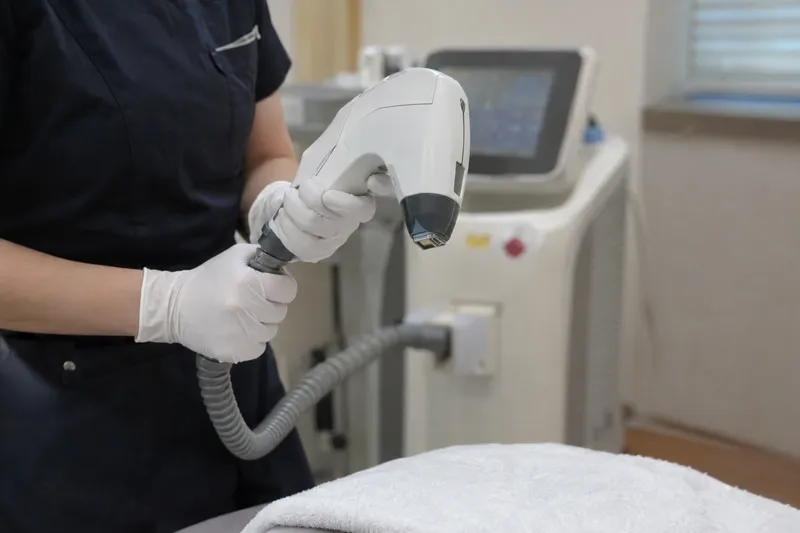
Mostly with lasers, over several sessions, and it is slower and less certain than the application was. A pigment laser breaks up particles so the body can clear them, and brow pigments are harder to clear than black body ink.
| Laser removal | Saline or lightening removal | |
|---|---|---|
| Done by | A medical clinic with a pigment laser | Studios and some clinics |
| Sessions | Several, spaced weeks apart | Several, spaced weeks apart |
| Main risk | Pigment shifting colour; temporary brow hair loss in the treated patch | Scarring if done aggressively; incomplete lightening |
| Realistic outcome | Significant fading, not always complete clearance | Lightening enough to cover with new work |
| When it is chosen | Dark, deep or unwanted pigment | Slightly wrong shape to be reworked |
The colour-shift risk is the one to understand before the first laser pass. Some brow pigments contain compounds that can darken or turn a different shade when hit with laser energy, which is why a test patch in an inconspicuous part of the brow is a normal request. The wider laser context is in the pigment laser page.
What does it cost, and is Korea actually cheaper?
Application is inexpensive here by international standards and removal is not cheap anywhere, because removal is measured in sessions across months.
For application, ask whether the retouch is included, whether numbing is included, and whether the price differs by technique — machine shading, hair-stroke work by hand, or a combination. For removal, ask for a per-session price and an estimated number of sessions, and assume the higher end.
The realistic bracket for application is rendered on the semi-permanent makeup page, and how this compares with an actual brow transplant is in eyebrow transplant in Korea.

What should you expect in the first month?
Too dark, then too light, then right. That sequence is normal and it is the reason not to judge the work on day three.
Days one to seven the pigment looks strong and the strokes look sharp, with light scabbing. Around week two it flakes and lightens, often dramatically, and a proportion of people are convinced at this point that it has failed. By week four to six the settled colour is visible and the retouch is planned against that, not against the day-one photograph.
Aftercare is dull and it decides the result: keep it dry as instructed, no scrubbing, no sauna or swimming, sunscreen once healed. Sun is what fades brow pigment fastest, which matters if your holiday continues somewhere bright. If you want to compare this against pigment for a hairline instead, that is in microblading versus transplant, and the matching form will shortlist clinics either way.