How Korea's national cancer screening works, and what visitors get instead
Written by KCODI medical interpreter team · English deskUpdated · 7 min read

The Korean national cancer screening program is the quiet reason Seoul has so many screening centres. Korea invites its residents for specific cancer checks at set ages and set intervals, through the national health insurance system, at little or no cost to them.
Decades of that has built something unusual: buildings designed for people who are not ill, staff who do the same tests all day, and results that come back in hours rather than weeks.
You cannot join that programme as a visitor. You can book the same tests privately, in the same buildings, on the same equipment. This explains what the programme covers, how Korean cancer patterns shaped it, and how to choose a package that suits where you live rather than where you are standing.
What the national programme covers
The programme targets a defined list of cancers where early detection is known to change outcomes, rather than trying to scan everything. The current list and the age bands are published by the National Cancer Center.
| Cancer | Usual test | Pattern |
|---|---|---|
| Stomach | Upper endoscopy | From the forties, on a repeating interval |
| Colorectal | Stool test, then colonoscopy if positive | From the forties, annually |
| Liver | Ultrasound and a blood marker | For higher-risk groups, more often |
| Breast | Mammogram | From the forties, on an interval |
| Cervical | Cervical smear | From the twenties, on an interval |
| Lung | Low-dose CT | For heavy smokers in a defined age band |
Notice what is not on the list. There is no routine whole-body MRI, no blanket tumour-marker panel and no annual full-body scan. Those appear on private menus, not in the national programme, and that difference is a useful filter when you compare packages.
Why the Korean list looks like this
Screening programmes follow what a population actually gets. Stomach and liver cancer have historically been far more common in Korea than in most Western countries, which is why a camera down the throat is an ordinary middle-aged errand here and an unusual request in London or Chicago.
The comparison people search for — cancer rate in Korea vs US — does not have a single answer, because the mix differs rather than the total. Different cancers dominate in different populations, and international comparisons are published by IARC. Skin cancer, for example, is a far smaller share of the Korean picture, which is why dermoscopy clinics are rarer here than screening endoscopy suites.
Who the programme actually covers
- Residents enrolled in Korean national health insurance, and people covered by Medical Aid, are invited according to age and risk group.
- Foreign nationals living in Korea and enrolled in the national insurance system are generally invited on the same basis. Check your own status with the insurance service rather than assuming.
- Employees often receive a workplace health screening as well, which is a separate track with its own schedule.
- Short-term visitors are not part of the programme. You book privately, pay the centre directly and choose your own package.
- Being outside the programme has one advantage: you are not limited to the national list, and you are not waiting for an invitation letter.
What a visitor books instead
Private packages in Seoul are usually tiered: a half-day basic checkup, a fuller day with endoscopy, and a premium tier adding MRI or CT. The estimated ranges are on our comprehensive checkup and cancer screening pages.
- Decide what you want answered. A general check, a specific worry and a family history are three different packages.
- Check what is standard and what is an upgrade. The chest x-ray is usually standard; the low-dose CT usually is not.
- Ask how and when results are delivered, and whether an English report is included or charged.
- Ask what happens if something needs follow-up: same-day specialist referral inside the hospital, or a letter for you to take home.
- Book it early in the trip. A result that needs a conversation is much easier while you are still in Seoul.
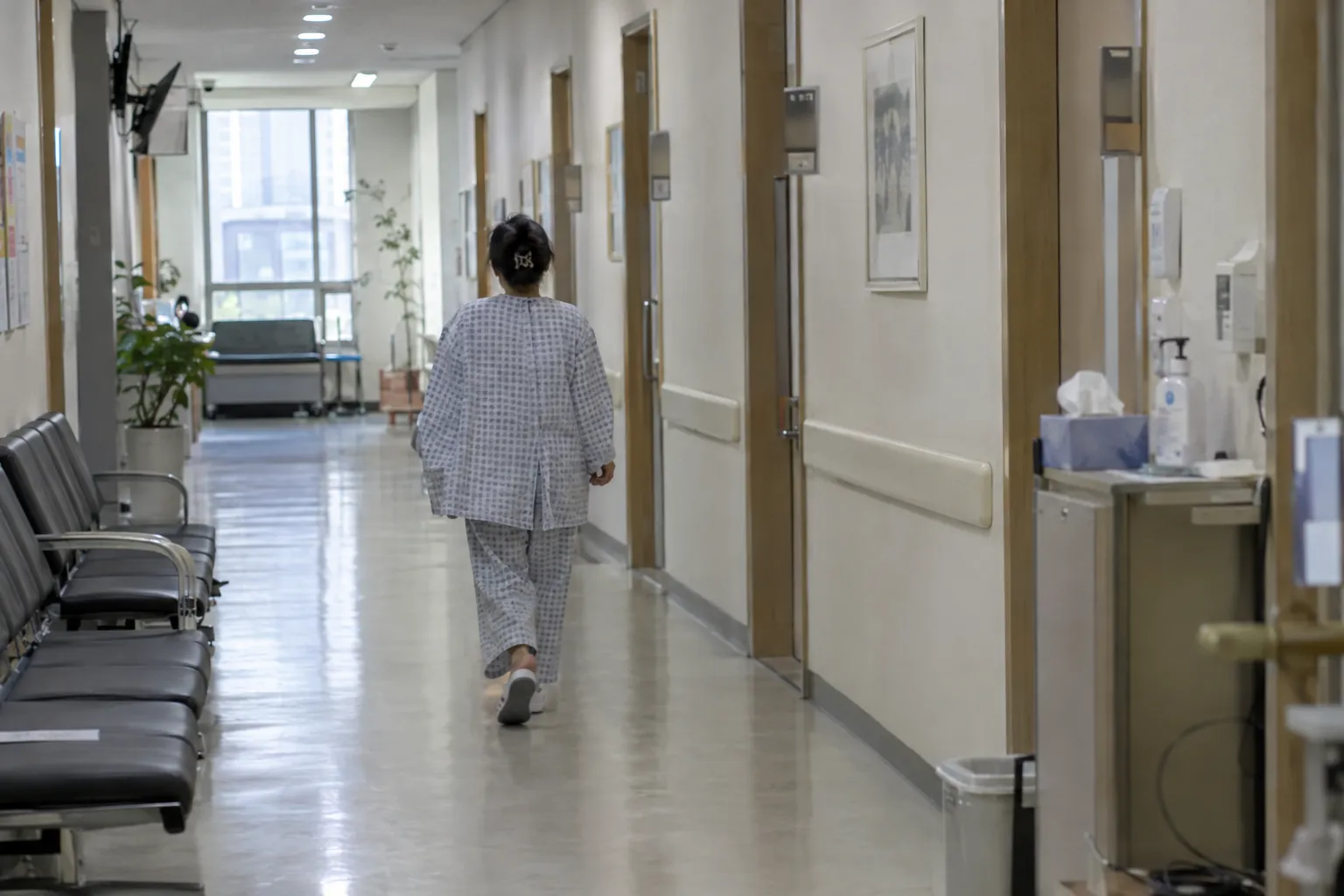
Screening is not diagnosis, and the difference matters
A screening test is offered to people with no symptoms, to find disease earlier than it would announce itself. A diagnostic test is ordered because something is already wrong. They can use identical machines and mean completely different things.
This matters for two reasons. If you have a symptom, a package is the wrong purchase: you want a consultation with a doctor who can order what your symptom requires, which our Korean hospital vs clinic guide explains how to reach. And a normal screening result means nothing was seen today, not that nothing can appear next year.
Every screening test also has a false positive rate, which is why programmes pick their tests carefully rather than scanning everything. A finding that turns out to be harmless still costs you a follow-up, a wait, and a few uncomfortable weeks. That is the trade you are making, and it is worth making knowingly.
The results conversation is the product
Korean centres are fast. Blood results, imaging and a doctor's summary often land the same day, with a bound report following. That speed is the reason people fly here for checkups, and it is also where the language gap bites hardest.
A screening report is written for another doctor. It lists everything, including the findings that mean nothing. Read alone in a hotel room through a translation app, an ordinary line about a benign cyst reads like a diagnosis.
Your interpreter sits in the results consultation, asks what the doctor would do if this were a Korean patient, and makes sure you leave with the files, not only the summary. The individual tests are covered in gastric screening, lung screening and thyroid ultrasound. To pick a centre, start at clinic matching or read Korean hospital vs clinic.