Non surgical body contouring in Korea: three mechanisms wearing a dozen brand names
Written by KCODI medical interpreter team · English deskUpdated · 8 min read

In shortEvery non-surgical body device in Seoul does one of three things: freeze fat, heat tissue, or contract muscle. Once you know which mechanism a machine uses, the twelve brand names on a clinic menu collapse into three decisions.
You want the shape without the surgery, and you have a week. So you start comparing non surgical body contouring Korea clinics advertise, and within three menus you have collected nine device names, four of which you cannot find in English anywhere.
Our interpreters read these menus in Korean all week, and the shortcut is simple. Ignore the brand names. Ask which of three mechanisms the machine uses, because that decides what it can move, how much downtime you get, and whether one session is worth the appointment.
This guide gives you the three mechanisms, maps the devices you will actually see onto them, and tells you honestly which ones do not make sense on a short trip.
What are the three mechanisms behind every body device?
Cooling, heating, and muscle stimulation. Cooling devices chill fat cells until some of them die — cryolipolysis. Heating devices use radiofrequency or focused ultrasound to tighten tissue and, at higher intensity, damage fat. Muscle devices use strong electromagnetic pulses to force contractions. Nothing else on the menu is a fourth category; everything is a variation.
| Mechanism | Device names you will see in Seoul | What it mainly changes | Downtime |
|---|---|---|---|
| Cryolipolysis (cooling) | Clatuu, CoolSculpting and similar | A pinchable fat bulge under an applicator | Numbness and bruising for days to weeks |
| Radiofrequency (heating) | Thermage for body, Exilis, InMode lines | Skin laxity, mild fat, texture | Redness for hours |
| Focused ultrasound (heating) | Body HIFU, body Shurink, ULFIT-type devices | Tightening, some fat with body settings | Soreness for 1–3 days |
| Muscle stimulation | Emsculpt and HIFEM-type devices | Muscle tone, not fat | Aching like hard exercise |
| Injection lipolysis | Fat dissolving injections | Small, localised fat pockets | Swelling, several days |
The mistake our interpreters correct most often: expecting a tightening device to remove fat, or a fat device to tighten skin. A 2025 systematic review and meta-analysis of cryolipolysis for body contouring reports measurable fat-layer reduction — and measurable is not the same as visible in clothes after one session. Regulators treat these as body-contouring devices, not weight-loss treatments.
Is body HIFU or body Shurink worth doing on a short trip?
For tightening, one session is a reasonable use of two hours. For fat reduction it is not — those need a series, and the change builds over two to three months, long after you have flown home.
Body HIFU in Seoul is usually priced by shot count, exactly like the facial version, and the shot count is where quotes diverge wildly. A quote for the abdomen with a low shot count and a quote with double the shots are not the same treatment at two prices; they are two treatments. Our guide to Shurink, Ultraformer and Oligio explains how shot counting works on the face, and the body logic is identical.
The practical detail nobody mentions: body ultrasound sessions are uncomfortable in a way facial ones are not, because the area is large and the session is long. Plan an easy evening. And do not book it the day before a long-haul flight — sitting still for eleven hours on a sore abdomen is a bad combination.
Does Clatuu or CoolSculpting work better for calves?
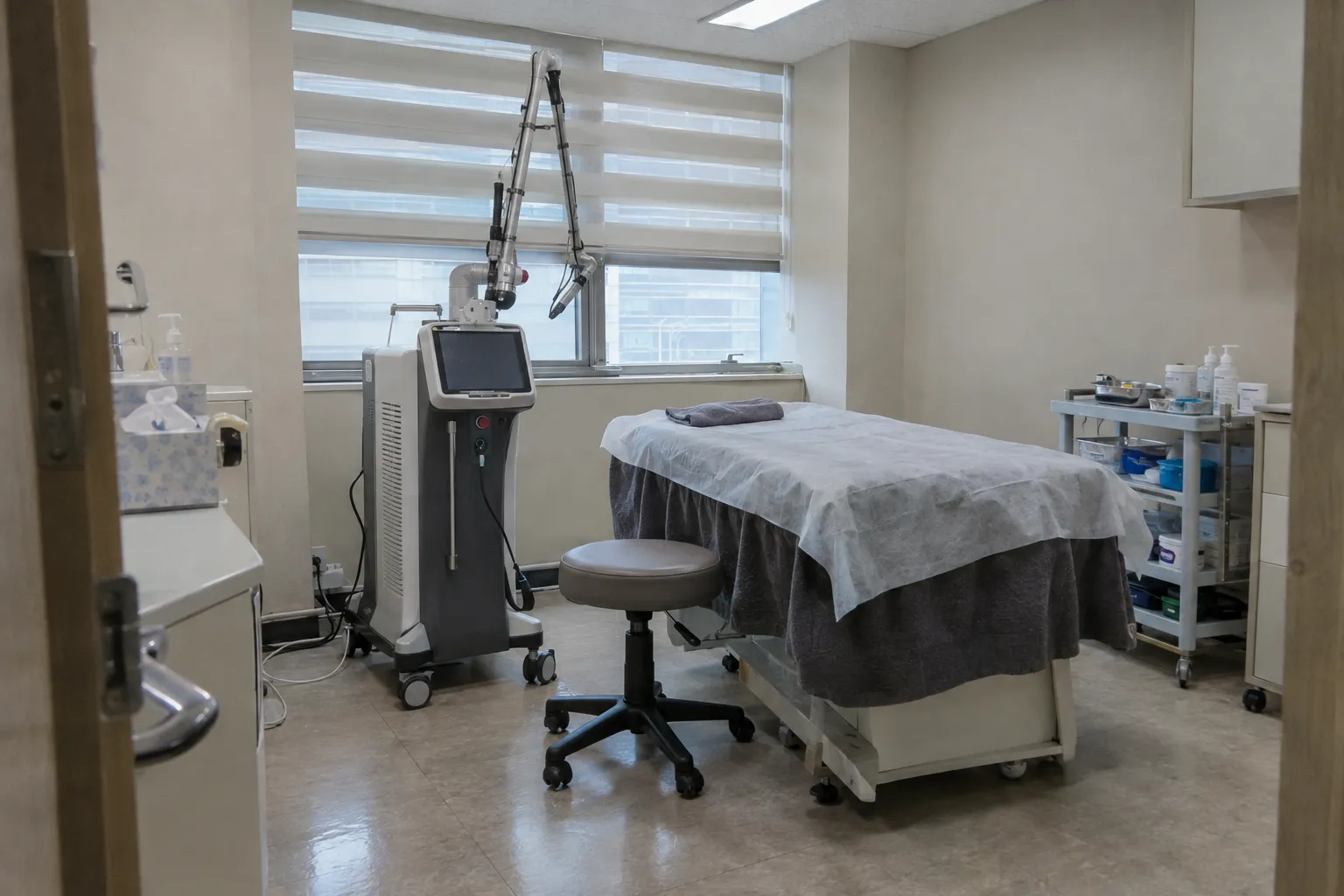
Cooling devices are a poor fit for calves, and a good clinic will say so. Cryolipolysis needs a fat bulge that can be drawn into an applicator, and most calves that look thick are thick because of muscle, not a pinchable fat pad.
That is why Korean clinics treat calves with botulinum toxin or, in selected cases, surgery rather than with a cooling cup. Our guide to calf reduction in Korea, botox versus surgery sets out both routes and what each costs in recovery time.
Where cooling does earn its place: the lower abdomen, flanks, inner thighs, the fat under the chin, and the small pad above the knee. One applicator cycle, a numb patch for a couple of weeks, and a gradual change over two to three months. For the pricing detail, see CoolSculpting in Korea.
What should I ask before booking a body device session?
Six questions, and the second one is the one that saves money.
- Which mechanism does this machine use — cooling, radiofrequency, ultrasound or muscle stimulation?
- How many sessions does this plan assume, and what will one session realistically do?
- How is it priced: per shot, per applicator cycle, per area, or per session? Get the unit written down.
- How long am I on the bed? Body sessions run far longer than facial ones.
- Who operates the device — a doctor, or a trained nurse under supervision?
- What are the known side effects for this specific device, and what do I do if numbness lasts beyond a few weeks?
Devices or liposuction: which one am I really looking for?
If your goal is a visible shape change in one trip, that is surgery. If your goal is mild tightening, a small stubborn pocket, or maintenance between more serious plans, devices are the right tool. Mixing up the two is the single most common reason patients feel they wasted money.
The comparison that matters is not price but downtime and reversibility. Liposuction means compression garments, a week or more of real recovery, and a permanent change — see the liposuction page and liposuction cost in Korea. A device session means you walk out and go to dinner, and the change is modest.
KCODI books at the local partner rate Korean patients use, with the itemised quote — including shot or cycle counts — in writing before any deposit, and a medical interpreter with you at no cost. Browse the whole Korean skin clinic menu, meet the interpreters, or answer four questions in clinic matching.