What is pico toning, and why do Korean clinics sell it ten sessions at a time?
Written by KCODI medical interpreter team · English deskUpdated · 6 min read

In shortPico toning is a low-energy picosecond laser pass over the whole face, repeated every one to two weeks, to fade pigment gradually. It is a course, not a single treatment, and one session is not meant to show much.
What is pico toning is the question people ask after a Gangnam coordinator quotes them ten sessions of something they did not come in for. It is the most Korean item on a dermatology menu: gentle, repeated, cumulative, and designed for a patient who lives twenty minutes away.
Toning means running a picosecond or nanosecond laser at low energy across the whole face rather than spot-treating a mark. Pigment is broken up slowly, the skin barely reacts, and the result appears over weeks as an evenness rather than a dramatic before-and-after.
That design is why visitors get confused by the price and the schedule. Below is how it works, what triple toning adds, and how to use it if you are only here for a week. The estimated range sits on the pigmentation laser page.
What does pico toning actually do?
It shatters pigment particles with extremely short pulses at energy low enough that your skin looks almost normal afterwards. The target is diffuse discolouration — freckles blurring together, melasma, post-acne marks, an overall dullness — rather than one dark spot you could point at.
Because the energy is low, the trade is obvious: very little downtime, very little per session. Slight warmth during the pass, mild pinkness for an hour or two, make-up the same day. People fly home the next morning without anyone noticing they had anything done, which is exactly the appeal and exactly why one session underwhelms.
- Usual Korean plan: five to ten sessions, one to two weeks apart.
- Whole-face pass, not spot treatment. A single stubborn spot is usually treated separately.
- Makeup same day in most clinics; sunscreen is non-negotiable throughout.
- Melasma is managed, not cured, and can rebound if the energy is pushed or the sun is not handled.
- Results judged across the course, with photographs in the clinic's own lighting.
Why is laser toning sold as a course?
Because the method depends on repetition. Each pass removes a fraction of the pigment, so the schedule is the treatment. Laser toning cost korea listings therefore quote a package, and the per-session figure you extract from it is not what a single visit is priced at.
This is the single biggest planning trap for visitors. Korean clinics assume you will come back next Tuesday. If you are in Seoul for five days you can have one or two sessions, which is a start on melasma and nothing like a course. Ask for the single-session price and the package price in one message, and ask what happens to sessions you cannot use.
Our dark spot treatment guide covers which marks respond to toning and which need a different laser, and the Korean clinic quote guide covers how packages are written.
What is triple toning?
A single appointment in which the operator uses more than one wavelength or handpiece in sequence — commonly a toning pass plus a second mode for vessels or texture. Triple toning laser korea is a clinic's program name rather than a technical standard, so the contents vary from clinic to clinic.
| Program | What it targets | Downtime | Typical course |
|---|---|---|---|
| Pico toning | Diffuse pigment, dullness, melasma | Pinkness for an hour or two | Five to ten, weekly or fortnightly |
| Triple toning | Pigment plus redness or texture in one visit | Similar, slightly more warmth | Five to ten |
| Spot treatment | One defined dark spot or lentigo | A small scab for a week | One, sometimes repeated |
| Picosecond resurfacing | Texture, pores, scars | Redness two to three days | Three to five, monthly |
| IPL | Redness with light pigment | Mild, a day | Three to five, monthly |
So triple toning is not automatically better; it is more things in one visit. Ask which modes are included and what each one is for. Our PicoSure, Genesis and IPL guide sets out the individual machines these programs are built from.
Are Korean-made pico lasers as good as the imported ones?
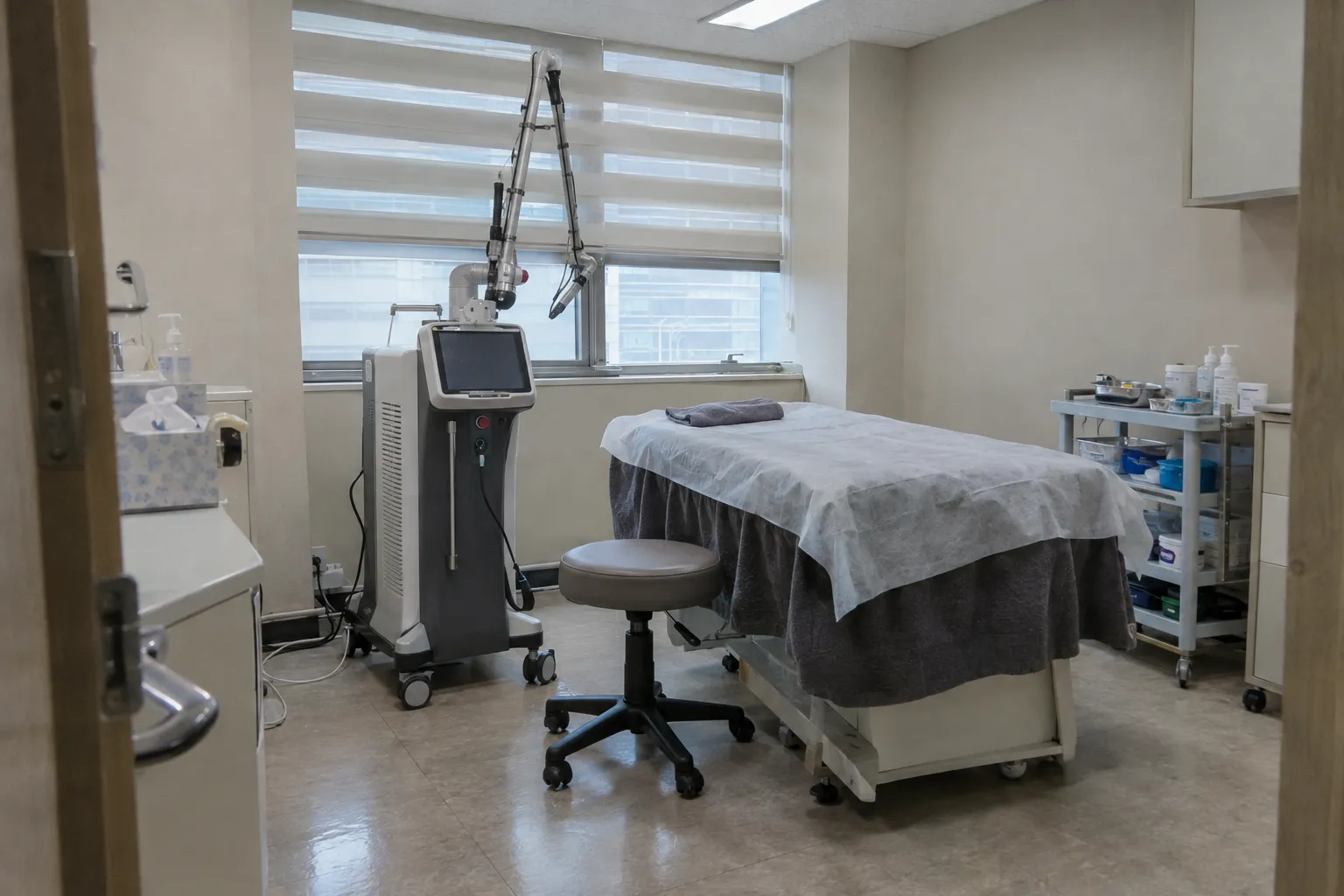
For toning, the operator's settings matter more than the badge on the box. Pico laser made in korea is a real category — Korean manufacturers build picosecond platforms that are exported worldwide — and they sit alongside imported machines on Seoul menus.
Korean pico pro laser searches usually mean one of the specific platforms a clinic advertises by name. The useful questions are the same either way: which machine, which wavelength, how many passes, how many sessions, and who operates it. A clinic that answers those five plainly is a safer bet than one with a famous machine and a vague plan.
One caution that applies to every machine in this family: toning on melasma can rebound if energy is pushed or sun exposure is not controlled. Korean dermatologists are generally conservative about this, and a clinic promising fast clearance of melasma is promising something the condition does not do.
How do you use toning on a one-week trip?
- Have the consultation on day one so any single session happens early in the trip.
- Ask for the single-session price, the package price, and the unused-session rule in the same message.
- If melasma is the diagnosis, ask what you continue at home: topical treatment and sunscreen do most of the work between sessions.
- Do not stack a strong resurfacing laser and a toning course in one week unless the doctor sequenced it.
- Hats, physical sunscreen, and no jjimjilbang or sauna on the day.
- Ask the clinic to photograph you in their lighting on day one, so any comparison later is fair.
Handled that way, one or two toning sessions in Seoul is a reasonable purchase: you get a proper diagnosis, a plan you can continue at home, and a mild improvement. Bought as ten sessions you will never attend, it is the most common wasted spend on a Korean dermatology trip.
If you would rather we mapped your pigment to a plan before you book flights, treatment matching takes about two minutes, or meet the interpreters who sit in on dermatology consultations.