Korean acne treatment for oily, dry and sensitive skin, for men and for teens
Written by KCODI medical interpreter team · English deskUpdated · 8 min read

In shortKorean acne treatment for oily skin is not the same plan as for dry or sensitive skin: the prescription changes, the in-clinic treatment changes, and the pharmacy can only supply part of it without a doctor.
Everyone told you to buy Korean skincare for it, you did, and it is still there. Korean acne treatment for oily skin is the search you run once you accept that the answer is a clinic and a prescription rather than another bottle.
Seoul dermatology handles acne in two parallel tracks, which is the thing visitors miss. One is medical: prescriptions, injections into individual lesions, occasionally a course of oral medication. The other is the care programme — extraction, calming, lasers — sold per session at the front desk.
The track you need depends on what kind of acne you have and what kind of skin it is sitting on. An oily, congested face and a dry, irritated, inflamed one get opposite instructions, and a clinic that gives both patients the same package is running a production line.
What does a Seoul dermatologist change for oily versus dry skin?
The strength and the vehicle. Oily, congested skin tolerates stronger topical retinoids and drying agents, so the plan leans on prescription actives and extraction. Dry or barrier-damaged skin inflames further under the same plan, so the doctor lowers the strength, slows the frequency, and repairs the barrier first.
That is why korean acne treatment for dry skin often begins with taking things away: fewer actives, no scrubs, a plain cleanser, and only then a low-frequency retinoid. It looks like doing less and it is a clinical decision, not a lazy one.
| Skin situation | Usual medical lean | In-clinic lean | What to avoid |
|---|---|---|---|
| Oily, congested, blackheads | Topical retinoid, stronger actives | Extraction, salicylic peels, occasional laser | Over-drying, twice-daily foaming cleansers |
| Dry, tight, flaking with breakouts | Lower-strength actives, barrier repair first | Gentle calming programmes, hydration | Scrubs, alcohol toners, stacked actives |
| Sensitive, red, stinging | Very gradual introduction, redness addressed separately | Calming devices, cool settings, vascular laser for redness | Aggressive peels and same-day stacking |
| Deep painful cysts | Doctor-led: injection into the lesion, oral options discussed | Drainage by a doctor, never by a facialist | Home extraction, waiting it out |
| Teen acne | Age-appropriate prescribing, guardian involved | Light programmes, education on routine | Adult-strength plans by default |
What can a Korean pharmacy actually give me without a doctor?
Less than the internet suggests. An acne treatment korea pharmacy visit will get you cleansers, some antibacterial and keratolytic products, spot patches and basic anti-inflammatory topicals. Prescription retinoids, oral antibiotics and any oral isotretinoin-type course require a doctor, in Korea as elsewhere.
Korean pharmacists are genuinely helpful and will point you at what is available over the counter, but they cannot prescribe, and there is no shortcut worth taking. If a shop offers you something that sounds prescription-strength without a doctor, walk out.
What the pharmacy is excellent for is the supporting cast: the plain cleanser, the sunscreen you actually need after any acne treatment, the patches for a single spot before a flight. The over-the-counter layer is covered in Korean acne spot treatment, and active breakouts in Korean acne treatment for active breakouts.
How are deep and back acne scars treated in Korea?
By type of scar, not by a single laser. Rolling and boxcar scars respond to fractional resurfacing and needling; ice-pick scars usually need a punch technique or focused ablative work; a raised or keloid scar is a different plan again.
- Fractional non-ablative lasers, including the Fraxel-type platforms, are the common first line over multiple sessions.
- Radiofrequency microneedling is often alternated with them, as set out in RF microneedling in Korea.
- Ablative CO2 is the heavier option with real downtime — crusting for roughly five to ten days, which means a long stay.
- Subcision for tethered scars, and filler or stimulator placement for depressed areas, are done by a doctor in the same clinic.
- Back acne scarring is treated on the same principles, with the caveat that back skin heals more slowly and pigments more readily. Pigment left behind is not a scar, and treating it as one wastes money.
The current bracket for scar work is rendered on the acne scar treatment page.
Does the plan change for men, and for teenagers?
It changes in practical ways rather than in principle. Men's skin is on average oilier and thicker, shaving irritates the same areas acne occupies, and beard-area inflammation is frequently not acne at all but folliculitis — which is treated differently.
So korean acne treatment for men usually includes the shaving conversation, and often a change of razor and aftershave before any prescription. Facial hair removal, when it is offered, is a separate decision and it is covered in Korean facial hair for men.
For teenagers, a Korean clinic will expect a guardian involved in the consultation and will prescribe conservatively, especially with any oral medication. Teen skin also responds well to the least glamorous part of the plan — routine, sunscreen, not picking — and a good doctor spends the appointment on that rather than upselling a package.
What should you get out of a single Seoul appointment?
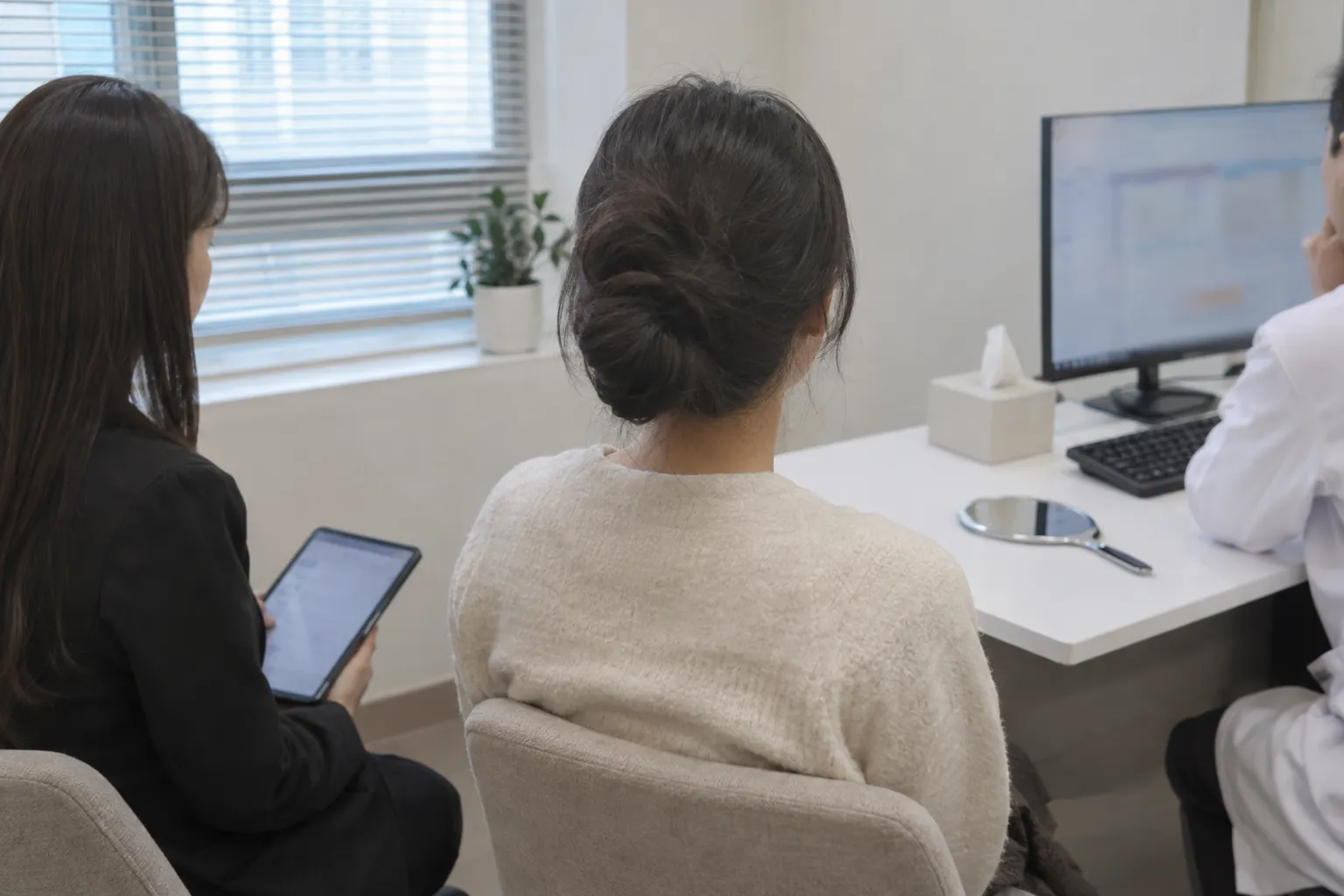
A diagnosis, a prescription you can refill at home, and a written plan. Not a ten-session package paid up front.
Ask for the generic names of anything prescribed, so your own pharmacy can dispense the equivalent. Ask whether the topical is available in your country. Ask what the plan is for month two and month three, because acne is a chronic condition managed over months and one appointment abroad cannot end it.
If your face is calm and the leftover problem is texture or marks, the plan is a scar plan and the sequence in Korean skin treatments compared will help you place it. To be matched with a clinic that will actually examine you, use the matching form or meet the interpreters.