A Korean head spa feels wonderful. It is not a hair loss treatment
Written by KCODI medical interpreter team · English deskUpdated · 7 min read
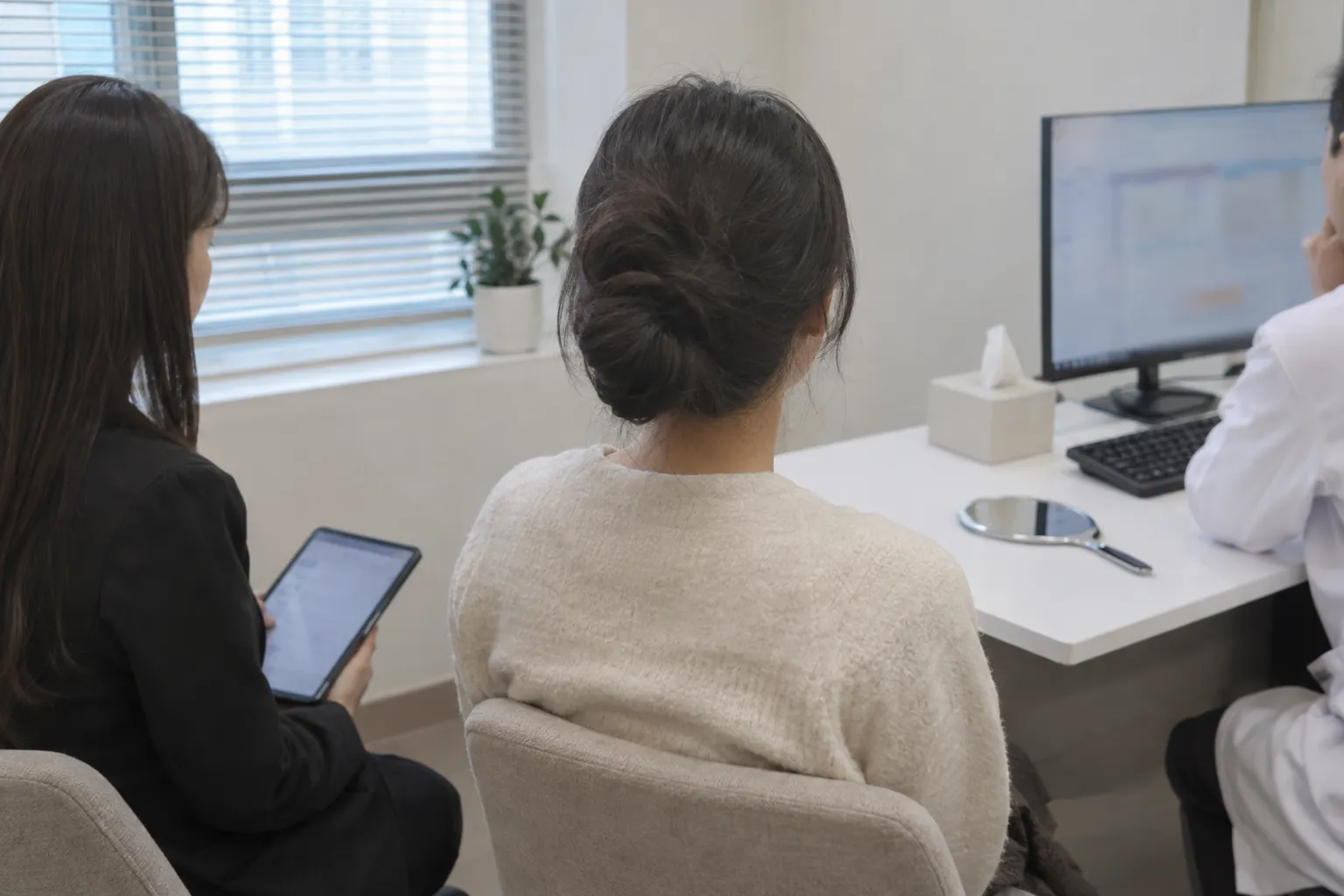
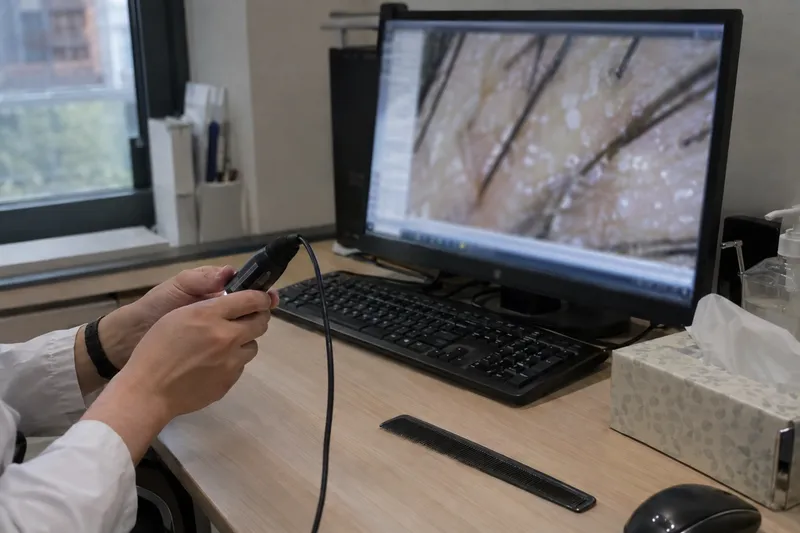
A Korean head spa is one of the most-booked experiences visitors add to a Seoul trip, and rightly so. An hour of warm water, careful massage, a scalp camera showing you your own follicles on a monitor, and you walk out feeling like a different person.
The confusion starts because the medical version looks similar from outside. Both use a magnifying camera. Both talk about pores and sebum. Both send you home with product recommendations.
The difference is whether anyone in the room can diagnose. If your hair is coming out in the shower, that difference is the entire question, and it is the reason this article exists.
Two appointments that look the same in photographs
| Head spa | Scalp clinic | |
|---|---|---|
| Who sees you | A trained therapist | A doctor, usually with a nurse or technician |
| What the camera is for | Showing you the scalp and guiding products | Assessing density, miniaturisation and inflammation |
| What you leave with | A clean, relaxed scalp and a home routine | A diagnosis, sometimes a prescription or an injection plan |
| Good for | Buildup, oiliness, stress, a treat | Shedding, itch that will not settle, visible thinning |
| Not good for | Anything that needs diagnosing | Being a lovely hour of your holiday |
Both are worth having. They answer different questions. The clinical menu and what it costs sits on the Korean scalp treatment page.
What a head spa genuinely does
It cleans thoroughly, removes buildup, and treats the scalp as skin rather than as a place hair happens to grow. That last idea is the useful part, and it is the one visitors take home.
The other genuine benefit is diagnostic by accident. Plenty of people have first noticed inflammation, flaking or a widening parting on a salon monitor, then taken it to a doctor. That is a good outcome, and it is the reason the two appointments are worth understanding rather than dismissing one of them.
- Deep cleansing for oily or product-heavy scalps, which does help how hair sits and feels.
- Massage, which is pleasant, relieves tension, and should not be sold as a treatment for hair loss.
- A look at your scalp on a monitor, which is genuinely informative even in a salon setting.
- A home routine, usually including washing more often than Western advice suggests, which suits humid Seoul summers.
- An hour of not being on your feet in Myeongdong, which after a procedure day is not nothing.
What it cannot do is change the course of pattern hair loss, treat a fungal problem or tell you why you are shedding. If somebody in a salon says a treatment will regrow hair, that is marketing, and the international hair-restoration societies have been warning about exactly that language for years.
What a Seoul scalp clinic actually offers
- An examination with a diagnosis: pattern hair loss, telogen effluvium after illness or stress, inflammation, or something else entirely.
- Medical treatment where appropriate, which may be topical, oral or injected, and which a doctor decides.
- Scalp injection courses, which are commonly sold to visitors and which work over months rather than in one visit.
- Device treatments such as low-level laser, offered as support rather than as the whole plan.
- A referral onwards if the answer is transplantation rather than treatment.
The awkward truth for a visitor is that almost all effective hair loss treatment is continuous. A course of injections in Seoul, with nothing afterwards, is a deposit on an outcome you never collect. Ask the doctor what the plan looks like once you are home, and expect that to be most of the conversation.
Timing matters for women in particular. Shedding that follows childbirth, illness, crash dieting or a stressful few months often recovers on its own over months, and knowing that saves an expensive course you did not need. A doctor can usually tell that pattern apart from pattern hair loss at a single examination.
If thinning has reached the point where coverage is the goal, the surgical route is in FUE hair transplant Korea, with costs in hair transplant cost in Korea per graft and the country comparison in hair transplant: Korea versus Turkey.
If you are getting a head spa anyway, do it well
Book it for a day when you have nothing planned afterwards, because your hair will be damp and undone for hours. Say if you have a sensitive scalp, eczema or psoriasis, and say if you are mid-course on any scalp treatment.
Bring a photograph of your parting taken in daylight a few months ago if you have one. It sounds trivial and it is the single most useful thing anyone brings to a scalp appointment, because memory is a poor witness and a monitor only shows today.
Do not have one immediately before or after a transplant, or during the healing period, without asking the surgeon. Do not let anyone put hot steam on a scalp that has recently had injections or surgery.
And treat the product recommendations as recommendations. The shampoo that suits a Seoul summer and Seoul water may not be what your scalp needs in a dry winter at home. A women's hairline plan, which is a different problem again, is covered on the female hairline transplant page. To be matched to the right kind of appointment, use clinic matching.