Severance hospital in Seoul: what to check before you book an appointment
Written by KCODI medical interpreter team · English deskUpdated · 8 min read

If you are reading reviews of severance hospital in seoul, you are usually not browsing. You have a diagnosis you want checked, a screening programme in mind, or a specialist appointment someone abroad has recommended, and you want to know whether the door opens for a foreign patient.
This page keeps to three things: what the hospital itself publishes, what has to be checked before booking at any Korean hospital or clinic, and how to get a written estimate and an interpreter before you buy a flight.
KCODI is a booking and medical-interpretation service. We are not affiliated with this hospital and we take no position for or against it.
What the official site states
The English site gives the address as 50-1 Yonsei-ro, Seodaemun-gu, Seoul 03722, on the Yonsei University campus in Sinchon rather than in the Gangnam clinic belt. The hospital sits inside Yonsei University Health System, and the site presents itself under that umbrella.
For foreign patients the site runs an International Health Care Center section, with an appointment guide, a visa section, billing and insurance, and special services. On language it states that translation and interpreting are always available in English, Japanese, Russian and Chinese, and that other languages can be arranged on request. It also states that the centre can give an estimated cost of treatment on request before medical consent, and that insurance is handled either by direct billing or on a pay-and-claim basis.
A health screening service is listed under the name Severance Health Checkup. Those are all the hospital's own statements as of the check date shown above. What a Korean comprehensive programme actually contains, and what moves the total up or down, is set out on our comprehensive health check-up page.
One name, several hospitals
This is the part that costs people a morning. The site lists, under the same health system, a cancer hospital, a cardiovascular hospital, a children's hospital, an eye hospital, a rehabilitation hospital and a dental college hospital, plus separate hospitals in Gangnam and in Yongin.
So a search result, a review and a taxi destination can all say the same name and mean different buildings, sometimes in different cities. Before you travel, three things need to be written down.
- Which hospital in the group your department belongs to, in full, not the short name.
- Which building and which floor the reception desk is on, since the campus has more than one entrance.
- Whether the appointment is with the international office or directly with a department, because the check-in desk differs.
- Whether results and the follow-up consultation are on the same day or a later one, which decides how many nights you book.
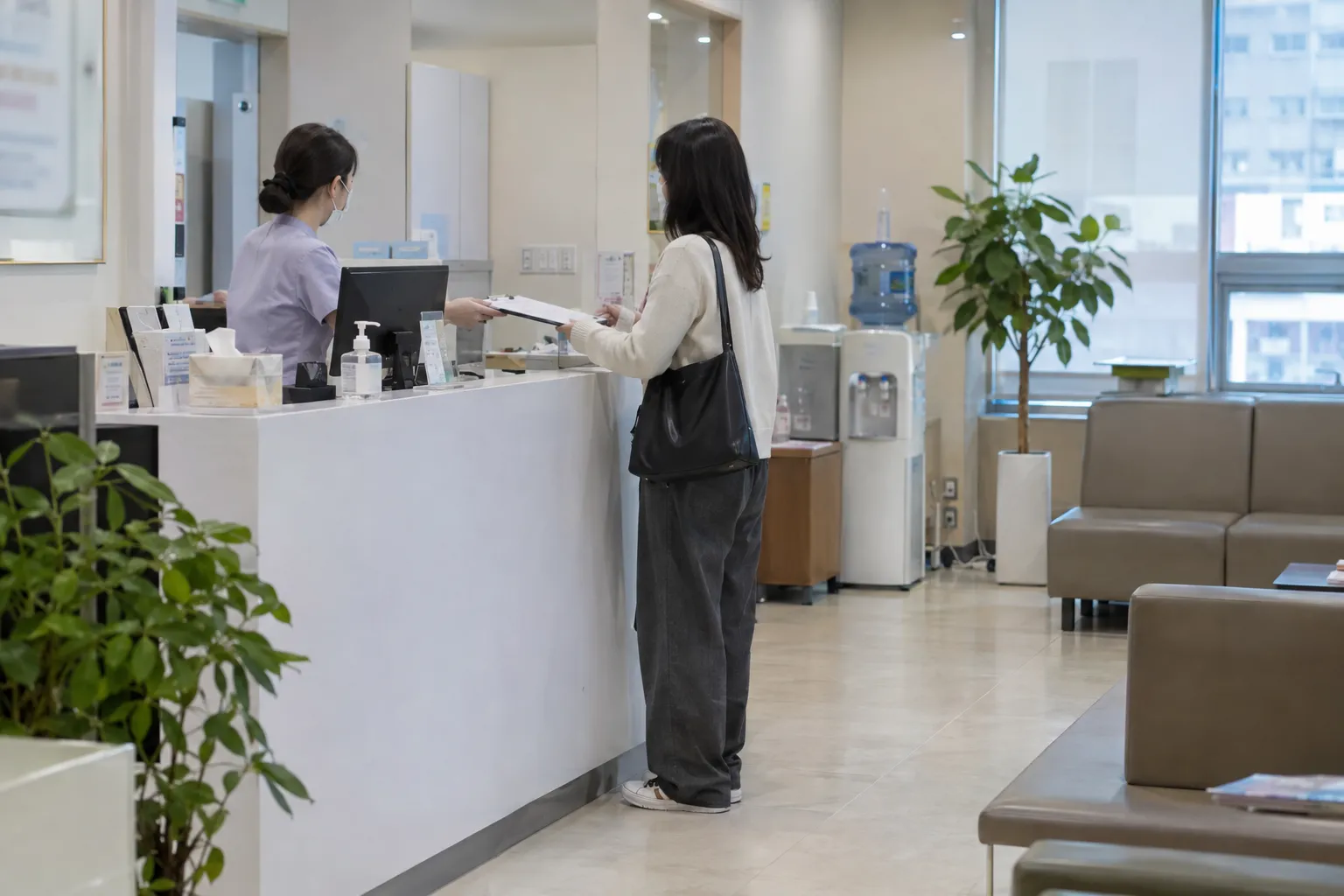
Six things to check before you book anywhere in Korea
The same six checks work for a university hospital and for a small clinic in Gangnam. None of them requires medical knowledge, and all six can be asked by message before any money moves.
| Check | Why it matters | How to ask |
|---|---|---|
| Who actually sees you | The person who consults is not always the person who treats | Ask for the name and the department of the doctor on the appointment |
| An itemised estimate | A single total hides tests, sedation, materials and follow-ups | Ask for the estimate line by line, in writing, before consent |
| Anesthesia cover | Sedation for endoscopy or surgery needs a specialist present | Ask who monitors you and whether they stay for the whole procedure |
| What happens if something is found | A follow-up test can add days you have not booked | Ask what the next step would be and on what timescale |
| Foreign-patient registration | Korea registers institutions permitted to treat foreign patients | Ask for the registration and check it yourself |
| Who interprets, and when | Reception language and consultation language are different jobs | Ask which appointments an interpreter attends, not whether one exists |
The fifth one is public information rather than something you have to take on trust, and our hospital versus clinic guide explains why the same six checks look different at the two levels of care.
How to read reviews of a hospital this size
Reviews of a university hospital are not reviews of your appointment. They pool thousands of visits across many departments, decades of visitors, and buildings that are not the one you are going to.
- Worth reading: how the international office replied, how long an appointment took to arrange, whether an interpreter was there for the consultation itself.
- Worth reading: whether records, imaging and results came back in a form a doctor at home could use.
- Skip: waiting times and crowding, which are structural in every tertiary hospital in every country.
- Skip: a review that compares a hospital with a private clinic. They are different levels of care and they are not in competition.
- Skip: any review that does not say which department it is about. Without that, it tells you nothing about yours.
If you are still deciding between institutions rather than within one, our guide to choosing a hospital as an international patient uses criteria you can verify instead of impressions you cannot.
Get a written estimate, and then a second one
Foreign visitors without Korean national health insurance pay an unsubsidised rate, and for screening or elective work the same programme can differ a great deal between institutions. One message is enough to have something to compare against.
You can meet the interpreters first, or use clinic matching if you are not yet sure which kind of appointment you need. If the honest answer is that the hospital is better contacted through its own international office, we say so.
Between the appointment email and the flight
The week before travel decides how much of the trip is spent repeating things you already have. A short order of operations helps.
- Collect your imaging on a disc or drive, not a report describing it, plus pathology results and a one-page timeline of what happened when.
- List your medication with generic drug names, including supplements and herbal preparations, since these affect sedation and bleeding.
- Confirm the fasting and preparation instructions in writing. For endoscopy they are exact, and arriving unprepared means rebooking.
- Book enough nights for tests, results and a follow-up consultation, which at a large hospital rarely all fall on one day.
- Check what your travel insurance excludes rather than what it covers. Planned screening and elective second opinions are usually excluded.
- Ask in advance whether results can be issued in English and whether imaging can be copied for you. Both are normally possible if you ask before you leave.
One more thing about thorough screening. Test enough healthy people and some results come back slightly outside the reference range without meaning anything, and Korean programmes test a great deal. A small nodule or a borderline marker is common and needs a doctor's reading rather than a search engine's. Ask what the recommended next step is, and write the answer down in the room. Our page on the national cancer screening programme explains how the system treats findings like these.
If you need help while you are in the country, the Medical Korea Support Center answers questions from foreign patients on +82-1577-7129, and the Korea Medical Dispute Mediation and Arbitration Agency handles complaints.